User guide
The goal of this page is to provide an introduction to the main features of the package: the scikit-learn and the PyTorch interfaces. We will demonstrate the main functionalities on a simple Linear Regression example.
Linear Regression
Given some feature vectors  and the corresponding target values
  , the goal is to learn a linear model
  that predicts the target value from the feature vector, i.e.,
  for all
  .
.
The most common approach to learn the parameters  and
and  is to minimize the empirical risk with the squared loss function:
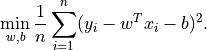
Solving the regression problem with scikit-learn
The linear regression problem can now be solved with the LinearRegression estimator from scikit-learn.
We assume that we are given X_train of shape (n_train, n_features) and y_train of shape (n_train,) as training data and X_test of shape (n_test, n_features) as test data.
from sklearn.linear_model import LinearRegression

# Fit the model
model = LinearRegression()
model.fit(X_train, y_train)

# Predict the target values
y_pred = model.predict(X_test)
Solving the robust regression problem with skwdro
Robust estimators from skwdro can be used as drop-in replacements for scikit-learn estimators (they actually inherit from scikit-learn estimators and classifier classes.)
skwdro provides robust estimators for standard problems such as linear regression or logistic regression.
LinearRegression from skwdro.linear_model is a robust version of LinearRegression from scikit-learn and be used in the same way. The only difference is that now an uncertainty radius rho is required.
from skwdro.linear_model import LinearRegression

# Uncertainty radius
rho = 0.1

# Fit the model
robust_model = LinearRegression(rho=rho)
robust_model.fit(X_train, y_train)

# Predict the target values
y_pred = robust_model.predict(X_test)
As a consequence, robust estimators can be tried and used without much change to existing pipelines!
By default, the LinearRegression estimator from skwdro uses will solve the robust optimization problem with entropic regularization and by calling a stochastic first-order solver in PyTorch. A dedicated solver can be used by setting the solver parameter in the constructor to 'dedicated'.
robust_model = LinearRegression(rho=rho, solver='dedicated')
Solving the regression problem with the PyTorch interface
The next section now describe the PyTorch interface of skwdro: it allows more flexibility, custom models and optimizers.
Assume now that the data is given as a dataloader train_loader.
import torch
import torch.nn as nn
import torch.optim as optim

from skwdro.torch import robustify

# Uncertainty radius
rho = 0.1

# Define the model
model = nn.Linear(n_features, 1)

# Define the loss function
loss_fn = nn.MSELoss()

# Define a sample batch for initialization
sample_batch_x, sample_batch_y = next(iter(train_loader))

# Robust loss
robust_loss = robustify(loss_fn, model, rho, sample_batch_x, sample_batch_y)

# Define the optimizer
optimizer = optim.Adam(model.parameters(), lr=0.01)

# Training loop
for epoch in range(100):
    for batch_x, batch_y in train_loader:
        optimizer.zero_grad()
        loss = robust_loss(batch_x, batch_y)
        loss.backward()
        optimizer.step()
This is the simplest use of the PyTorch interface: just wrap the usual loss and model with the robustify function and use the resulting loss function in the training loop.
To make the optimization of the robust model more efficient, we also provide an learning-rate free optimizer tailored to this problem.
# Adaptive optimizer
optimizer = robust_loss.optimizer