Note
Go to the end to download the full example code.
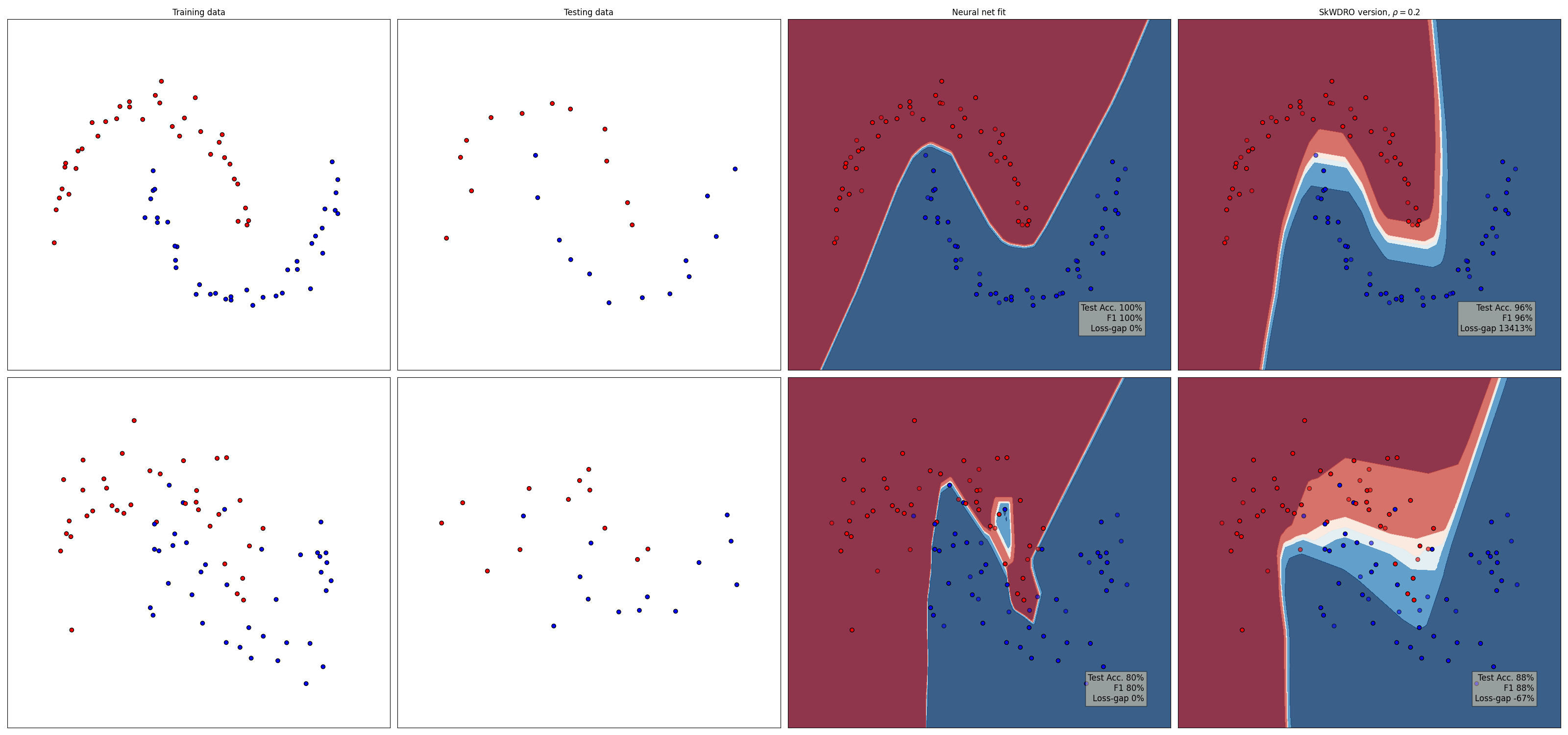
Robustify a neural-net on spatial perturbations of the “moons” non-convex dataset#
This example illustrates the use of the skwdro.torch.robustify wrapper to solve non-convex datasets that are shifted at test time with a PyTorch neural network.
It showcases the ease of use of the interface, and the way you can wrap the estimator easily in a scikit-learn pipeline.
import numpy as np

from sklearn.datasets import make_moons

from typing import Optional
import numpy as np
import torch as pt
import torch.nn as nn
from sklearn.base import BaseEstimator, ClassifierMixin
from sklearn.utils.validation import check_X_y, check_array, check_is_fitted
from sklearn.utils.multiclass import unique_labels
from sklearn.preprocessing import LabelEncoder, OneHotEncoder
from sklearn.exceptions import DataConversionWarning
from scipy.special import expit


from skwdro.base.problems import EmpiricalDistributionWithLabels
from skwdro.base.losses_torch.logistic import BiDiffSoftMarginLoss
from skwdro.solvers.optim_cond import OptCondTorch
from skwdro.base.cost_decoder import cost_from_str

import skwdro.solvers.entropic_dual_torch as entTorch
from skwdro.wrap_problem import dualize_primal_loss

from utils.classifier_comparison import plot_classifier_comparison
Bellow is a simple neural network architecture to classify (2-classes) the moons
dataset. It’s almost a 1-to-1 copy of the skwdro.linear_model.LogisticRegression.
By default, it contains only 1 hidden layer of 32 neurons.
So its shape/architecture is \(\mathbb{R}^2\to\mathbb{R}^32\to\mathbb{R}\)
Note
Try it at home! Change the architecture and try to see how it changes the results and the stability of the algorithm.
class NeuralNetClassifier(BaseEstimator, ClassifierMixin):
    r""" A Wasserstein Distributionally Robust neural classifier.


    Parameters
    ----------
    rho: float, default=1e-2
        Robustness radius
    l2_reg: float, default=None
        l2 regularization
    fit_intercept: boolean, default=True
        Determines if an intercept is fit or not
    cost: str, default="n-NC-1-2"
        Tiret-separated code to define the transport cost:
         "<engine>-<cost id>-<k-norm type>-<power>"
         for :math:`c(x, y):=\|x-y\|_k^p`
    solver: str, default='entropic_torch'
        Solver to be used: 'entropic', 'entropic_torch'
        (_pre or _post) or 'dedicated'
    solver_reg: float | None, default=None
        regularization value for the entropic solver, has
        a default heuristic
    sampler_reg: float | None, default=None
        standard deviation of the regularization distribution :math:`\pi_0`, has
        a default heuristic
    learning_rate: float | None, default=None
        if not set, use a default value depending on the problem, else
        specifies the stepsize of the gradient descent algorithm
    n_zeta_samples: int, default=10
        number of adversarial samples to draw
    opt_cond: Optional[OptCondTorch]
        optimality condition, see :py:class:`OptCondTorch`

    Attributes
    ----------
    coef_ : array, shape (n_features,)
        parameter vector (:math:`w` in the cost function formula)
    intercept_ : float
        constant term in decision function.
    """
    DEFAULT_OCOND = OptCondTorch(2, 1e-4, 0.)

    def __init__(self,
                 rho: float = 1e-2,
                 n_hidden_layers: int = 1,
                 n_hidden_neurons: int = 32,
                 l2_reg: float = 0.,
                 fit_intercept: bool = True,
                 cost: str = "t-NLC-2-2",
                 solver="entropic_torch",
                 solver_reg: Optional[float] = None,
                 sampler_reg: Optional[float] = None,
                 learning_rate: Optional[float] = None,
                 n_zeta_samples: int = 10,
                 random_state: int = 0,
                 opt_cond: Optional[OptCondTorch] = DEFAULT_OCOND
                 ):

        if rho < 0:
            raise ValueError(
                ' '.join([
                    "The uncertainty radius rho should be",
                    "non-negative, received",
                    f"{rho}"
                ])
            )

        self.rho = rho
        assert n_hidden_layers > 0
        self.n_hidden_layers = n_hidden_layers
        self.n_hidden_neurons = n_hidden_neurons
        self.l2_reg = l2_reg
        self.cost = cost
        self.fit_intercept = fit_intercept
        self.solver = solver
        self.solver_reg = solver_reg
        self.sampler_reg = sampler_reg  # sigma
        self.learning_rate = learning_rate
        self.opt_cond = opt_cond
        self.n_zeta_samples = n_zeta_samples
        self.random_state = random_state

    def fit(self, X, y):
        """Fits the WDRO classifier.

        Parameters
        ----------
        X : array-like, shape (n_samples, n_features)
            The training input samples.
        y : array-like, shape (n_samples,)
            The target values. An array of int. Only -1 or +1 are currently
            supported

        Returns
        -------
        self : LogisticRegression
            Returns self.
        """
        # Check that X and y have correct shape
        X, y = check_X_y(X, y)
        X = np.array(X)
        y = np.array(y)

        # Type checking for rho
        if self.rho is not float:
            try:
                self.rho = float(self.rho)
            except BaseException:
                raise TypeError(
                    ' '.join([
                        "The uncertainty radius rho should be"
                        f"numeric, received {type(self.rho)}"
                    ])
                )

        if len(y.shape) != 1:
            y = y.ravel()
            raise DataConversionWarning(
                f"Given y is {y.shape}, while expected shape is (n_sample,)")

        # Store the classes seen during fit
        self.classes_ = unique_labels(y)

        # Encode the labels
        if len(self.classes_) == 2:
            # Binary classification
            self.le_ = LabelEncoder()
            y = self.le_.fit_transform(y)
            if y is None:
                raise ValueError(
                    "Problem with labels, none out of label encoder"
                )
            else:
                y = np.array(y, dtype=X.dtype)
            y[y == 0.] = -1.
        elif len(self.classes_) > 2:
            # Multiclass classification
            self.le_ = OneHotEncoder(sparse_output=False)
            y = self.le_.fit_transform(y[:, None])
            if y is None:
                raise ValueError(
                    "Problem with labels, none out of label encoder"
                )
            else:
                y = np.array(y, dtype=X.dtype)
        else:
            raise ValueError(
                ' '.join([
                    f"Found {len(self.classes_)} classes,",
                    "while (at least) 2 are expected."
                ])
            )

        # Check type
        if not np.issubdtype(X.dtype, np.number):
            raise ValueError(f"Input X has dtype  {X.dtype}")

        # Store data
        self.X_ = X
        self.y_ = y

        # Setup problem parameters ################
        m, d = np.shape(X)
        self.n_features_in_ = d
        samples_y = y[:, None] if len(self.classes_) == 2 else y
        emp = EmpiricalDistributionWithLabels(
            m=m,
            samples_x=X,
            samples_y=samples_y
        )

        # Define cleanly the hyperparameters of the problem.
        self.cost_ = cost_from_str(self.cost)
        # #########################################

        if self.solver == "entropic":
            raise DeprecationWarning(
                "The entropic (numpy) solver is now deprecated"
            )
        elif "torch" in self.solver:
            _post_sample = (
                self.solver in ("entropic_torch", "entropic_torch_post")
            )
            assert len(self.classes_) == 2
            module_out = 1
            loss = BiDiffSoftMarginLoss(reduction='none')
            self.wdro_loss_ = dualize_primal_loss(
                loss,
                nn.Sequential(
                    nn.Linear(
                        self.n_features_in_,
                        self.n_hidden_neurons,
                        bias=self.fit_intercept
                    ),
                    nn.ReLU(),
                    *[
                        (
                            nn.Linear(
                                self.n_hidden_neurons,
                                self.n_hidden_neurons,
                                bias=self.fit_intercept
                            ) if i % 2 == 0 else nn.ReLU()
                        )
                        for i in range(2 * self.n_hidden_layers)
                    ],
                    nn.Linear(
                        self.n_hidden_neurons,
                        module_out,
                        bias=self.fit_intercept
                    )
                ),
                pt.tensor(self.rho),
                pt.Tensor(emp.samples_x),
                pt.Tensor(emp.samples_y),
                _post_sample,
                self.cost,
                self.n_zeta_samples,
                self.random_state,
                learning_rate=self.learning_rate,
                sigma=self.sampler_reg,
                epsilon=self.solver_reg,
                imp_samp=_post_sample,  # hard set
                adapt="prodigy" if self.learning_rate is None else None,
                l2reg=self.l2_reg
            )
            self.wdro_loss_.n_iter = 50, 200

            # The problem is solved with the new "dual loss"
            self.coef_, _, self.dual_var_, self.robust_loss_ = entTorch.solve_dual_wdro(
                self.wdro_loss_,
                emp,
                self.opt_cond  # type: ignore
            )

            self.coef_ = (
                self
                .wdro_loss_
                .primal_loss
            )

        # Unknown solver
        else:
            raise NotImplementedError()
        self.is_fitted_ = True

        # Return the classifier
        return self

    def predict_proba_2Class(self, X):
        """ Robust prediction probability for class +1.

        Parameters
        ----------
        X : array-like, shape (n_samples, n_features)
            The input samples.

        Returns
        -------
        p : ndarray, shape (n_samples,)
            The probability of class +1 for each of the samples.
        """
        # Check is fit had been called
        check_is_fitted(self, ['X_', 'y_'])

        # Input validation
        X = check_array(X)

        p = expit(
            self.wdro_loss_.primal_loss.transform(pt.tensor(X).to(self.wdro_loss_.rho))  # type: ignore
                .squeeze(-1).detach().cpu().numpy()
        )
        return p

    def predict_proba(self, X):
        """ Robust prediction probability for classes -1 and +1.

        Parameters
        ----------
        X : array-like, shape (n_samples, n_features)
            The input samples.

        Returns
        -------
        p : ndarray, shape (n_samples,2)
            The probability of each class for each of the samples.
        """
        # Check is fit had been called
        check_is_fitted(self, ['X_', 'y_'])

        # Input validation
        X = check_array(X)

        p = expit(
            self.wdro_loss_.primal_loss.transform(pt.from_numpy(X).to(self.wdro_loss_.rho))  # type: ignore
                .squeeze(-1).detach().cpu().numpy()
        )
        return np.vstack((1 - p, p)).T

    def predict(self, X):
        """ Robust prediction.

        Parameters
        ----------
        X : array-like, shape (n_samples, n_features)
            The input samples.

        Returns
        -------
        y : ndarray, shape (n_samples,)
            The label for each sample is the label of the closest sample
            seen during fit.
        """
        # Check is fit had been called
        check_is_fitted(self, ['X_', 'y_'])

        # Input validation
        X = check_array(X)
        X = np.array(X)

        if isinstance(self.le_, LabelEncoder):
            proba = self.predict_proba_2Class(X)
            out = self.le_.inverse_transform((proba >= 0.5).astype('uint8'))
        elif isinstance(self.le_, OneHotEncoder):
            proba = self.predict_proba(X)
            _p = proba >= np.max(proba, axis=1, keepdims=True)
            out = self.le_.inverse_transform(
                _p.astype('uint8')
            )
        else:
            raise ValueError(
                "The label encoder type {type(self.le_)} is not supported."
            )
        return out
Setup#
Variance grows from (.05, .1) to (.1, .5), to try to trick the model.
n = 100 # Total number of samples
n_train = (3 * n) // 4 # Number of training samples
n_test = n - n_train # Number of test samples

sdevs = [(.05, .1), (.1, .5)]

# Create datasets with variance that is shifted at test time
datasets = []
for (sdev_1, sdev_2) in sdevs:
    train_dataset = list(make_moons(n_samples=n_train)) # type: ignore
    train_dataset[0] += np.array([sdev_1, sdev_2]) * np.random.randn(n_train, 2)
    test_dataset = list(make_moons(n_samples=n_test)) # type: ignore
    test_dataset[0] += np.array([sdev_2, sdev_1]) * np.random.randn(n_test, 2)
    datasets.append((train_dataset, test_dataset))
WDRO classifiers#
We set two radii: 0 for ERM (the SkWDRO interfaces will handle it) and 0.2 is the radius picked for the robust classifier, which is the right one for the 2-Wasserstein distance between the variances we picked earlier.
rhos = [0, .2]

# Cost:
# t: torch backend
# NLC: norm cost that takes labels into account
# 2 2 : squared 2-norm
cost = f"t-NC-2-2"

# WDRO classifier
classifiers = [NeuralNetClassifier(rho=rho, cost=cost) for rho in rhos]
Make plot#
  0%|          | 0/2 [00:00<?, ?it/s]
  0%|          | 0/2 [00:00<?, ?it/s,
                0.001/0.001
            ]
 50%|█████     | 1/2 [00:00<00:00,  3.03it/s,
                0.001/0.001
            ]
 50%|█████     | 1/2 [00:01<00:00,  3.03it/s,
                0.075/0.001
            ]
100%|██████████| 2/2 [00:01<00:00,  1.54it/s,
                0.075/0.001
            ]
100%|██████████| 2/2 [00:01<00:00,  1.67it/s,
                0.075/0.001
            ]

  0%|          | 0/2 [00:00<?, ?it/s]
  0%|          | 0/2 [00:00<?, ?it/s,
                1.054/1.054
            ]
 50%|█████     | 1/2 [00:00<00:00,  2.62it/s,
                1.054/1.054
            ]
 50%|█████     | 1/2 [00:01<00:00,  2.62it/s,
                0.341/1.054
            ]
100%|██████████| 2/2 [00:01<00:00,  1.50it/s,
                0.341/1.054
            ]
100%|██████████| 2/2 [00:01<00:00,  1.61it/s,
                0.341/1.054
            ]
Total running time of the script: (0 minutes 2.720 seconds)