Note
Go to the end to download the full example code.
Study the relationship between ERM, WDRO, and SkWDRO#
This example illustrates the use of the skwdro.linear_models.LogisticRegression class on datasets that are shifted at test time.
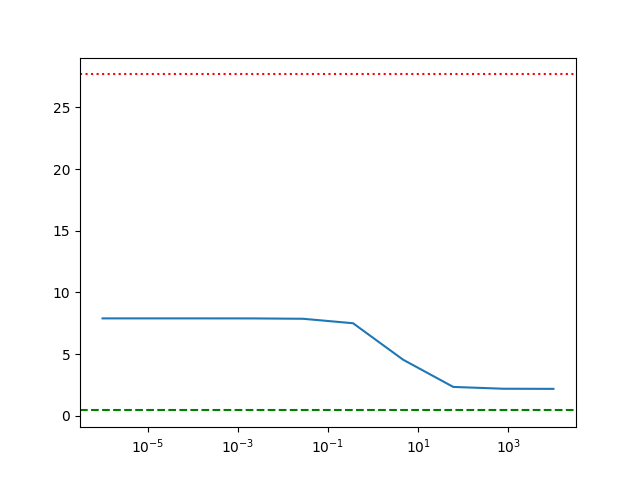
It showcases the approximation properties of the SkWDRO estimator with respect to the non-regularized Wasserstein-distributionally robusst estimator (WDRO), and the Empirical Risk estimator (ERM).
This is possible because the WDRO estimator is available through a “closed form”, see (Shafieezadeh-Esfahani-Kuhn, 2015)
import numpy as np

from sklearn.datasets import make_blobs

from skwdro.torch import robustify
from sklearn.linear_model import LogisticRegression
from scipy.optimize import line_search
from skwdro.linear_models._logistic_regression import BiDiffSoftMarginLoss

import torch as pt
import torch.nn as nn
import matplotlib.pyplot as plt
from tqdm import tqdm


N_LAMBDA_OPTIM_STEPS = 100
Here is the forward pass for a given lambda, at fixed parameters
@pt.no_grad()
def fwd(model, l, X, y):
    model._lam = pt.nn.Parameter(pt.tensor(l))
    return model(X, y).detach().numpy()
Then pick one of the two following functions to find lambda: * either pick a satisfying multiplier with the strong-Wolfe-Armijo criterion, * or optimize it by hand with vanilla gradient descent.
def line_optim_Wolfe(
    model,
    X: pt.Tensor, y: pt.Tensor,
    old_loss: pt.Tensor
) -> tuple[float, float]:
    """
    "either pick a satisfying multiplier with the strong-Wolfe-Armijo criterion" option
    """
    def f(l):
        return fwd(model, l, X, y)
    def f_prime(l):
        model._lam = pt.nn.Parameter(pt.tensor(l))
        loss = model(X, y)
        loss.backward()
        assert model._lam.grad is not None
        return model._lam.grad.detach().numpy()
    def extra_condition(a, l, f, g):
        del a, f, g
        return l >= 0
    old_l = model._lam.detach().numpy()
    g = model._lam.grad.detach().numpy()
    alpha, *misc = line_search(
        f, f_prime,
        old_l,
        pk=-g,
        gfk=g,
        old_fval=old_loss.detach().numpy(),
        c1=0.01, c2=0.999,
        extra_condition=extra_condition,
        maxiter=N_LAMBDA_OPTIM_STEPS
    )
    if alpha is None:
        if g >= 0.:
            return np.inf, np.inf
        else:
            return 0., f(0.)
    else:
        assert misc[2] is not None
        return (old_l - alpha * g).item(), misc[2]

def line_optim(
    model,
    X: pt.Tensor, y: pt.Tensor,
    old_loss: pt.Tensor
) -> tuple[float, float]:
    """
    "or optimize it by hand with vanilla gradient descent" option
    """
    def f_prime(l):
        model._lam = pt.nn.Parameter(l)
        loss = model(X, y)
        loss.backward()
        assert model._lam.grad is not None
        return loss, model._lam.grad
    def extra_condition(a, l, f, g):
        del a, f, g
        return l >= 0
    lam = pt.zeros_like(model._lam.detach())
    f = past_f = old_loss
    s = 0
    for iter in range(N_LAMBDA_OPTIM_STEPS):
        f, g = f_prime(lam)
        lam -= 0.01 * g
        if not extra_condition(None, lam, f, g):
            lam *= 0.
        if pt.abs(f - past_f) < 1e-5:
            s += 1
            if s == 10:
                break
        past_f = f

    return lam.detach().cpu().item(), f.detach().cpu().item()
Setup#
We build a custom 2-blobs dataset.
n = 50 # Total number of samples

sdevs = (1, 5) # train on this, plan to test on wider variance or different means

# Fix centers for blobs dataset
pos = 4
centers = [np.array([-pos,-pos]), np.array([pos,pos])]

# Create datasets with variance that is shifted at test time
X_train, y_train = make_blobs(n_samples=n, centers=centers, cluster_std=sdevs) # type: ignore
WDRO classifiers#
The exact 1-WDRO loss for the linear classifier is given by (Shafieezadeh-Esfahani-Kuhn, 2015):
- ..math::
frac{1}{N}sum_{i=1}^NL(xi_i)+rho|theta|_*
In this case we pick the two-norm for our euclidean space.
rho = 2*4**2

# Enthropic regularization: test various ones
regs = np.logspace(
    -6, 4,
    base=10,
    num=10 # try 100 at home
)

# Cost:
# t: torch backend
# NC: norm cost that does not take labels into account
# 1 2 : 2-norm (not squared!)
cost = f"t-NC-1-2"

erm_model = LogisticRegression(fit_intercept=False).fit(X_train, y_train)
erm_params = (erm_model.coef_, erm_model.intercept_)

# WDRO classifier
X_train, y_train = pt.from_numpy(X_train), pt.from_numpy(y_train).double().unsqueeze(-1)

loss = BiDiffSoftMarginLoss(reduction='none')
linear_model = nn.Linear(2, 1, bias=False)
linear_model.weight = pt.nn.Parameter(pt.from_numpy(erm_params[0]))
# linear_model.bias = pt.nn.Parameter(pt.from_numpy(erm_params[1]))
linear_model = linear_model.to(X_train)

wdro_loss = loss(
    linear_model(X_train), y_train
).mean() + rho * pt.linalg.norm(linear_model.weight.flatten())
classifiers = [
    robustify(
        loss,
        linear_model,
        pt.tensor(rho),
        X_train,
        y_train,
        cost_spec=cost,
        epsilon=eps,
        n_samples=10 # Try 1000 at home
    ) for eps in regs
]

skwdro_losses = []
for c in tqdm(classifiers):
    c.freeze()
    c._lam.requires_grad_()
    loss_before = c(X_train, y_train)
    loss_before.backward()
    lam, skloss = line_optim(c, X_train, y_train, loss_before)
    skwdro_losses.append(skloss)
  0%|          | 0/10 [00:00<?, ?it/s]
 70%|███████   | 7/10 [00:00<00:00, 63.95it/s]
100%|██████████| 10/10 [00:00<00:00, 68.80it/s]
Make plot#
fig, ax = plt.subplots()
# Save your plots if you wish to
# np.savez_compressed("./epsiloncurve.npz", l=skwdro_losses, e=regs)
ax.semilogx(regs, np.array(skwdro_losses), label='$\\varepsilon$-robust loss')
ax.axhline(wdro_loss.detach().item(), color='r', label='WDRO', linestyle='dotted')
ax.axhline(loss(linear_model(X_train), y_train).mean().detach().item(), color='g', label='ERM', linestyle='--')
plt.show()
Total running time of the script: (0 minutes 0.209 seconds)