Note
Go to the end to download the full example code.
Polynomial regression
Polynomial regression is a simple 1D regression. The samples are of the form  and the sought predictor is of the form
  where
where  are the
  coefficients to lean.
In the following example, we seek to learn a polynomial fitting the function
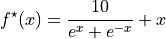
from  samples uniformly drawn from
 ![[-2,2]](../../_images/math/823d07519c23547f4c38cbb0d22525beb5f47106.png) and corrupted by a Gaussian noise with zero mean and variance
and corrupted by a Gaussian noise with zero mean and variance  .
.
from typing import Iterable
import numpy as np
import matplotlib.pyplot as plt
import torch as pt
import torch.nn as nn
from torch.utils.data import TensorDataset, DataLoader
from tqdm import tqdm

from skwdro.torch import robustify
from skwdro.solvers.oracle_torch import DualLoss
Problem setup
n = 100                                     # Number of observations

var = pt.tensor(0.1)                        # Variance of the noise

def f_star(x):                              # Generating function
    return 10/(pt.exp(x)+pt.exp(-x)) + x

xi = pt.rand(n)*4.0 - 2.0                   # x_i's are uniformly drawn from (-2,2]
xi = pt.sort(xi)[0]                         # we sort them for easier plotting
yi = f_star(xi) + pt.sqrt(var)*pt.randn(n)  # y_i's are f(x_i) + noise

dataset = DataLoader(TensorDataset(xi.unsqueeze(-1), yi.unsqueeze(-1)), batch_size=n//2, shuffle=True)

degree = 4                                  # Degree of the regression

device = "cuda" if pt.cuda.is_available() else "cpu"
Polynomial model
class PolynomialModel(nn.Module):
    def __init__(self, degree : int) -> None:
        super().__init__()
        self._degree = degree
        self.linear = nn.Linear(self._degree, 1)

    def forward(self, x):
        return self.linear(self._polynomial_features(x))

    def _polynomial_features(self, x):
        return pt.cat([x ** i for i in range(1, self._degree + 1)],dim=-1)

model = PolynomialModel(degree).to(device)  # Our polynomial regression model
loss  = nn.MSELoss(reduction='none')        # Our error will be measure in quadratic loss
Training loop
def train(dual_loss: DualLoss, dataset: Iterable[tuple[pt.Tensor, pt.Tensor]], epochs: int=10):

    lbfgs = pt.optim.LBFGS(dual_loss.parameters())   # LBFGS is used to optimize thanks to the nature of the problem

    def closure():          # Closure for the LBFGS solver
        lbfgs.zero_grad()
        loss = dual_loss(xi, xi_label, reset_sampler=True).mean()
        loss.backward()
        return loss

    pbar = tqdm(range(epochs))

    for _ in pbar:
        # Every now and then, try to rectify the dual parameter (e.g. once per epoch).
        dual_loss.get_initial_guess_at_dual(*next(iter(dataset))) # *

        # Main train loop
        inpbar = tqdm(dataset, leave=False)
        for xi, xi_label in inpbar:
            lbfgs.step(closure)

        pbar.set_postfix({"lambda": f"{dual_loss.lam.item():.2f}"})

    return dual_loss.primal_loss.transform
Training
  0%|          | 0/5 [00:00<?, ?it/s]

  0%|          | 0/2 [00:00<?, ?it/s]

 50%|█████     | 1/2 [00:00<00:00,  9.88it/s]


  0%|          | 0/5 [00:00<?, ?it/s, lambda=4469.09]
 20%|██        | 1/5 [00:00<00:00,  6.69it/s, lambda=4469.09]

  0%|          | 0/2 [00:00<?, ?it/s]


 20%|██        | 1/5 [00:00<00:00,  6.69it/s, lambda=292.16]

  0%|          | 0/2 [00:00<?, ?it/s]


 20%|██        | 1/5 [00:00<00:00,  6.69it/s, lambda=293.42]
 60%|██████    | 3/5 [00:00<00:00, 10.32it/s, lambda=293.42]

  0%|          | 0/2 [00:00<?, ?it/s]

100%|██████████| 2/2 [00:00<00:00, 13.94it/s]


 60%|██████    | 3/5 [00:00<00:00, 10.32it/s, lambda=286.42]

  0%|          | 0/2 [00:00<?, ?it/s]

100%|██████████| 2/2 [00:00<00:00, 16.96it/s]


 60%|██████    | 3/5 [00:00<00:00, 10.32it/s, lambda=293.42]
100%|██████████| 5/5 [00:00<00:00,  8.61it/s, lambda=293.42]
100%|██████████| 5/5 [00:00<00:00,  8.69it/s, lambda=293.42]

PolynomialModel(
  (linear): Linear(in_features=4, out_features=1, bias=True)
)
Results
We plot the obtained polynomial and print the coefficients
fig, ax = plt.subplots()
xtrial = pt.linspace(-2.1,2.1,100)
ax.scatter(xi.cpu(), yi.cpu(), c='g', label='train data')
ax.plot(xtrial, f_star(xtrial), 'k', label='generating function')

pred1 = model1(xtrial[:,None,None]).detach().cpu().squeeze() # type: ignore
ax.plot(xtrial,pred1, 'r', label='WDRO prediction')

fig.legend()
plt.show()


coeffs = model1.linear.weight.tolist()[0] # type: ignore
biais  = model1.linear.bias.tolist()[0] # type: ignore
polyString = "Polynomial regressor (degree {:d}, radius {:3.2e}):\n {:3.2f} ".format(degree,radius.float(),biais)
for i,a in enumerate(coeffs):
    if a>=0.0:
        polyString += "+ {:3.2f}x**{:d} ".format(a,i+1)
    else:
        polyString += "- {:3.2f}x**{:d} ".format(abs(a),i+1)

print(polyString)
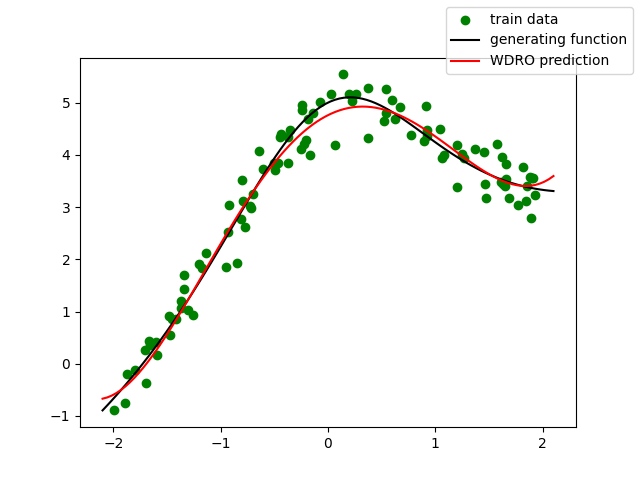
Polynomial regressor (degree 4, radius 1.00e-03):
 4.76 + 1.03x**1 - 1.64x**2 - 0.00x**3 + 0.20x**4
Different degree and radius, with a more compact formulation.
  0%|          | 0/5 [00:00<?, ?it/s]

  0%|          | 0/2 [00:00<?, ?it/s]

 50%|█████     | 1/2 [00:00<00:00,  9.36it/s]

100%|██████████| 2/2 [00:00<00:00,  8.66it/s]


  0%|          | 0/5 [00:00<?, ?it/s, lambda=4040500.25]
 20%|██        | 1/5 [00:00<00:00,  4.31it/s, lambda=4040500.25]

  0%|          | 0/2 [00:00<?, ?it/s]

 50%|█████     | 1/2 [00:00<00:00,  7.51it/s]

100%|██████████| 2/2 [00:00<00:00,  7.11it/s]


 20%|██        | 1/5 [00:00<00:00,  4.31it/s, lambda=343521.34]
 40%|████      | 2/5 [00:00<00:00,  3.82it/s, lambda=343521.34]

  0%|          | 0/2 [00:00<?, ?it/s]

 50%|█████     | 1/2 [00:00<00:00,  6.19it/s]

100%|██████████| 2/2 [00:00<00:00,  6.06it/s]


 40%|████      | 2/5 [00:00<00:00,  3.82it/s, lambda=295055.28]
 60%|██████    | 3/5 [00:00<00:00,  3.40it/s, lambda=295055.28]

  0%|          | 0/2 [00:00<?, ?it/s]

 50%|█████     | 1/2 [00:00<00:00,  5.94it/s]

100%|██████████| 2/2 [00:00<00:00,  5.98it/s]


 60%|██████    | 3/5 [00:01<00:00,  3.40it/s, lambda=296239.22]
 80%|████████  | 4/5 [00:01<00:00,  3.21it/s, lambda=296239.22]

  0%|          | 0/2 [00:00<?, ?it/s]

 50%|█████     | 1/2 [00:00<00:00,  5.99it/s]

100%|██████████| 2/2 [00:00<00:00,  6.01it/s]


 80%|████████  | 4/5 [00:01<00:00,  3.21it/s, lambda=295597.41]
100%|██████████| 5/5 [00:01<00:00,  3.12it/s, lambda=295597.41]
100%|██████████| 5/5 [00:01<00:00,  3.28it/s, lambda=295597.41]
fig, ax = plt.subplots()
xtrial = pt.linspace(-2.1,2.1,100)
ax.scatter(xi.cpu(), yi.cpu(), c='g', label='train data')
ax.plot(xtrial, f_star(xtrial), 'k', label='generating function')

pred2 = model2(xtrial[:,None,None]).detach().cpu().squeeze() # type: ignore
ax.plot(xtrial,pred2, 'r', label='WDRO prediction')

fig.legend()
plt.show()


coeffs = model2.linear.weight.tolist()[0] # type: ignore
biais  = model2.linear.bias.tolist()[0] # type: ignore
polyString = "Polynomial regressor (degree {:d}, radius {:3.2e}):\n {:3.2f} ".format(degree2,radius2.float(),biais)
for i,a in enumerate(coeffs):
    if a>=0.0:
        polyString += "+ {:3.2f}x**{:d} ".format(a,i+1)
    else:
        polyString += "- {:3.2f}x**{:d} ".format(abs(a),i+1)

print(polyString)
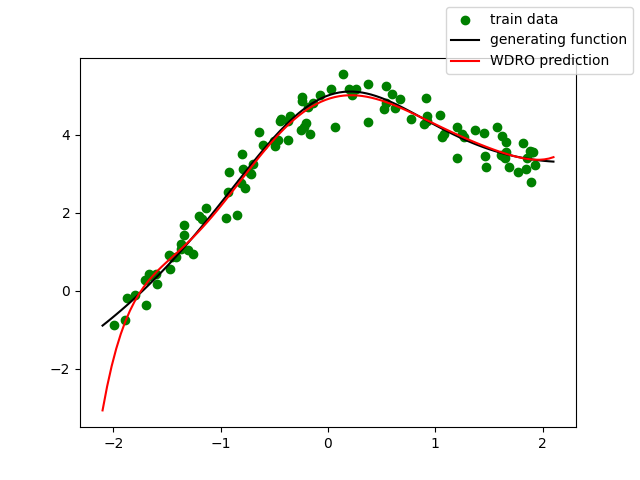
Polynomial regressor (degree 7, radius 1.00e-06):
 4.91 + 0.93x**1 - 2.31x**2 + 0.29x**3 + 0.71x**4 - 0.21x**5 - 0.10x**6 + 0.04x**7
Total running time of the script: (0 minutes 2.238 seconds)